
Plastic Bins vs. Cardboard Boxes – Which Is Best for Moving?
Plastic bins are generally the better choice for moving since they’re more durable. However, traditional cardboard boxes still remain a popular choice for quick, low-cost moves. Deciding between the two comes down to your budget, the distance of your move, and how much protection your items need.
Our mission at Stack Moves is to make moving easier with our sturdy, reusable plastic moving boxes. Made from recycled plastic and backed by 1,100+ Trustpilot reviews, our bins are a simpler, more sustainable way to safely move your belongings. Contact us today to book your moving boxes.
At the end of this blog, you’ll have a clear understanding of the pros and cons of plastic bins and cardboard boxes in order to make the best choice for your move.
Table Of Contents
Plastic Bins vs. Cardboard Boxes: A Side-by-Side Breakdown
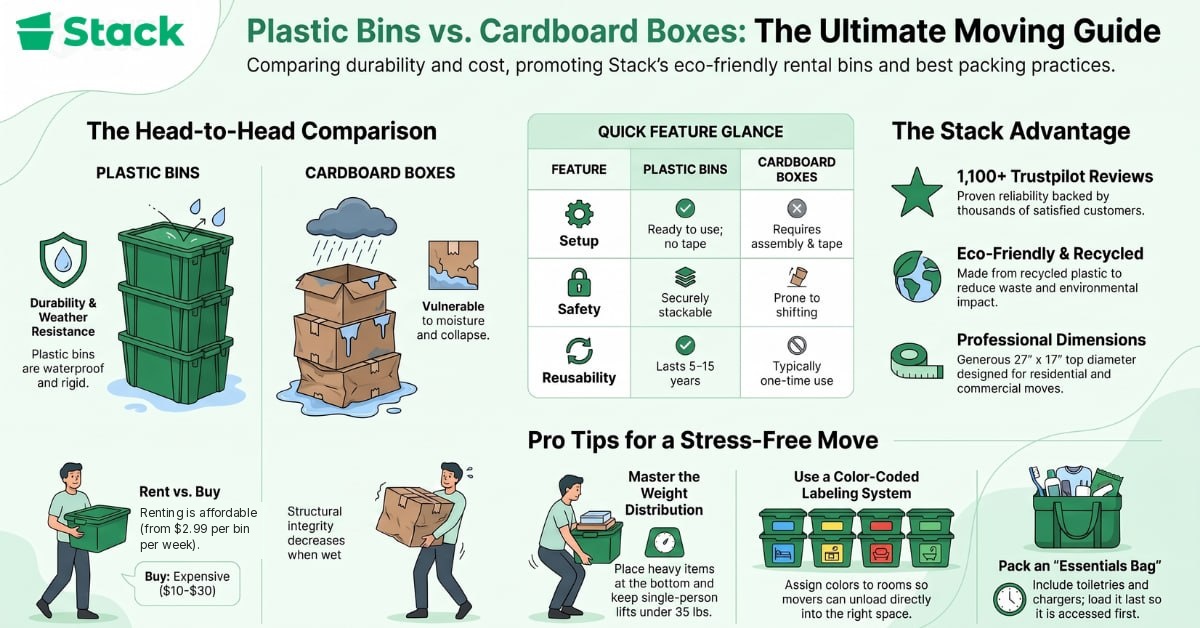
While both options can get your belongings from point A to point B, they perform very differently when compared across factors such as cost and durability. Here’s how plastic bins and cardboard boxes stack up against each other.
Plastic Moving Boxes

Plastic bins are sturdy, reusable containers built for both residential and commercial moves. They typically measure around 27″ by 17″ at the top, narrowing to 24.5″ by 14.5″ at the base, and are standing about 13″ tall.
Sean McGrath explains that “the biggest advantage plastic bins have over cardboard boxes is durability.” With proper care they can last 5 to 15 years. They’re also water-resistant, which makes them a safer bet for rainy moving days or damp storage areas. When compared to cardboard boxes, plastic bins do a better job at protecting your belongings.
The trade-off is the upfront cost associated with buying them. Plastic boxes usually cost $10-$30. You can rent plastic bins from $2.99 per bin per week, which is why we always recommend renting them instead. Depending on how much space you have, plastic bins can be a pain to store, since they don’t fold flat the way cardboard does.
Bottom line: plastic bins cost more upfront but pay off in protection and reusability. These boxes are best suited for delicate items, moist weather, or movers who’ll use them more than once.
Cardboard Moving Boxes
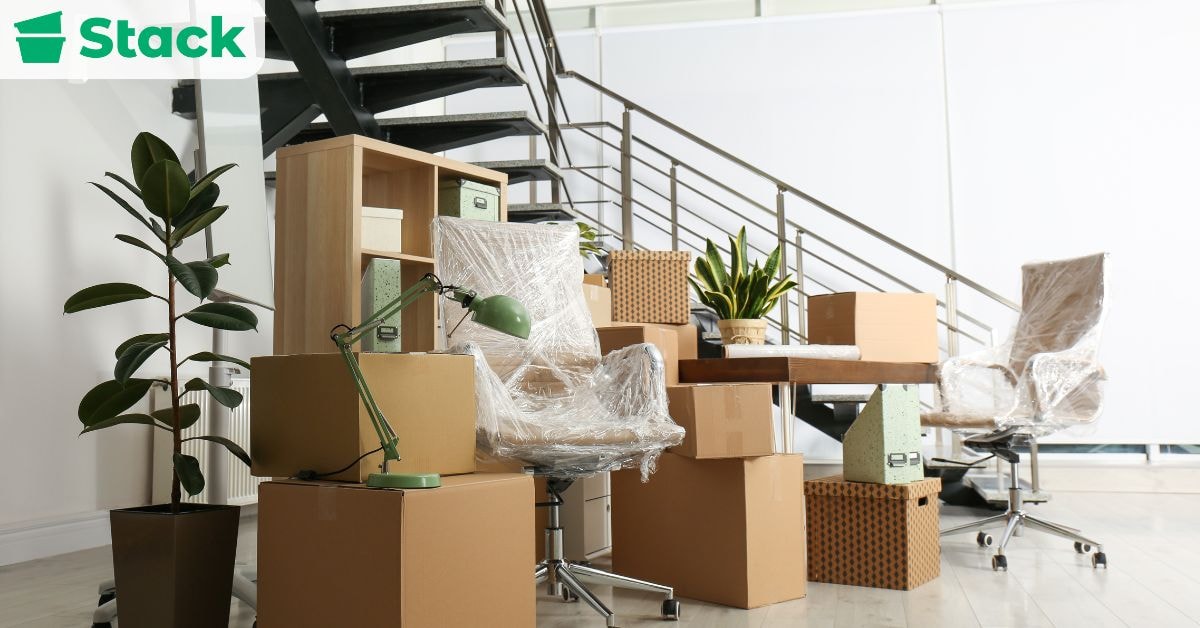
Cardboard boxes remain the most widely used option for both residential and commercial moves. This is majorly because of how versatile and easy to find they are. They come in various types, from standard boxes to specialized boxes like cardboard wardrobe boxes. Your average cardboard box can comfortably hold up to 50 pounds. However, official OSHA Ergonomic Manual Lifting Guidelines recommend keeping single-person lifts under 35 pounds to prevent injury.
Their biggest advantage is that they cost less than plastic containers, and it’s often possible to find them for free. Cardboard boxes cost $1-$8 depending on size and quality, but they are prone to damage and they may not offer the best protection for your fragile items.
Where cardboard falls short is durability. Standard boxes can tear or collapse under too much weight, though this can be managed with corrugated boxes. Cardboard is also vulnerable to moisture. They become soggy and lose strength in humid environments, so they’re a poor fit for rainy moves or damp storage. Plus, they’re not as secure as plastic bins. While plastic bins have a lockable lid, boxes rely on tape to stay sealed, making them easier to accidentally (or deliberately) open.
Bottom line: cardboard boxes are a budget-friendly, easy-to-find option. They’re perfect for short, dry moves where cost matters more than long-term durability.
Feature Comparison Table | Cardboard vs. Plastic Bins
| Feature | Plastic Bins | Cardboard Boxes |
|---|---|---|
| Durability | Won’t tear or collapse | Prone to damage |
| Waterproof | Protects against moisture | Susceptible to moisture |
| Reusability | Can be used multiple times | Typically one-time use |
| Stackability | Secure stacking, no shifting | Prone to shifting and collapsing |
| Eco-Friendliness | Durable, reducing the need to frequently replace it | Recyclable but often disposed of after use |
| Convenience | Ready to use, no assembly | Requires tape & setup |
| Best For | Hassle-free, secure moves | Budget-friendly, short-term use |
Which One Should You Choose for Your Move?

The right pick really comes down to a few things: what you’re moving, how far it’s going, your budget, and what you’re doing with the containers once you’ve unpacked.
Got Fragile Stuff to Move?
Plastic bins are the more reliable option. Their rigid sides protect against knocks a lot better than cardboard does. Cardboard’s still fine for big, heavy items, but if something’s especially heavy, a plastic bin’s extra strength keeps it from tearing under the weight.
Moving Across Town or Across the Country?
For long-distance relocations, plastic bins provide peace of mind against rough handling. While we admit that cardboard boxes are cheaper and sometimes even free, they tend to bang up easily. This doesn’t mean they’re entirely obsolete — cardboard boxes are still a great option for light packing.
Thinking About the Environment?
Cardboard is recyclable, but plastic bins are built to be reused again and again. This cuts down on how much new material has to be made and tossed out.
Need Somewhere to Store Your Containers After the Move?
When empty, cardboard is collapsible, which is great if you’re short on room. Plastic storage bins take up a bit more space, but they hold their shape much better over time, so anything you’re storing long-term stays protected.
Tips for Efficient Packing Regardless of Choice

Whether you go with bins or boxes, the same five steps keep a move organized from the first container to the last.
- Start with the right container size. Choosing the right size of boxes or bins does most of the work for you. Heavier items like books should go in small boxes to prevent overloading. Lighter items like blankets and comforters can be packed in larger boxes without the risk of them becoming too heavy.
- Pack tightly, then cushion the gaps. Items should be packed tightly to prevent movement, but not so tight that they cause damage. Use packing materials such as bubble wrap, packing paper, or towels to fill empty spaces and provide cushioning for fragile items.
- Load heavy at the bottom, light on top. Always place heavier items at the bottom of the box or bin and lighter items on top to prevent damage. For fragile items, consider using specialty cardboard boxes such as dish packs or wardrobe boxes, which provide greater protection and are designed for specific needs.
- Seal every container properly. Make sure cardboard boxes are taped securely at the bottom and top. Plastic totes with lids should be closed and secured to prevent them from opening during the move.
- Label before you load. Labeling your containers is necessary for an easier move. “Setting up a simple labeling system for your boxes lets the moving crew unload directly into the right space,” says Sean McGrath. Use a bold marker on every container and include the contents and the room it belongs to. You can also color-code instead: assign a color to each room and use colored stickers or tape to mark your moving boxes.
One last thing before the truck arrives: pack an essentials bag with everything you’ll need on the first day in your new home. These essentials could be toiletries, medications, chargers, snacks, and basic tools. Make sure this is labeled clearly and loaded last so it can be accessed first.
Need Plastic Boxes for Moving?
How smooth or stressful your move turns out largely depends on the boxes you use. Although cardboard boxes are a nice option because of their availability and affordability, they come with various limitations. Plastic bins are sturdier, weather-resistant, easy to stack, and reusable — making them ideal for both short- and long-term storage.
But to avoid the financial strain associated with purchasing them, renting presents itself as the ideal solution. You get all the benefits of plastic bins without the hefty price tag or the clutter once you’re done. Reach out to us today!
Frequently Asked Questions
Got more questions about which option is best for you? We answered the most common ones below to help you prepare. If your question is not covered here, feel free to reach out to our team anytime.
Is It Better to Move With Plastic Bins or Boxes?
Plastic bins are generally considered a better option for moving because of their durability. They are better at protecting fragile items and hold up better in humid environments. You can still use cardboard boxes for your move if you’re planning a short-distance move. We also recommend them for anyone working with a tight budget since you can often get them for free.
Do Movers Prefer Boxes or Totes?
Most professional movers prefer uniform, stackable containers, which is where plastic totes have the edge. Totes hold their shape on a loaded truck, stack without shifting, and don’t need to be taped shut before every trip. Cardboard boxes are still welcome on a job — crews handle them every day — but odd sizes, weak bottoms, and boxes packed past 50 pounds are what slow a crew down. Whichever you choose, uniform sizes and honest labeling matter more to a moving crew than the material itself.
Which Type of Box Is Best?
Heavy-duty corrugated boxes are usually the best containers to move with. Small boxes are ideal for handling heavy loads like books without falling apart. Medium boxes work well for cookware and other household goods, while large boxes can be used to pack bulky but light items.
What Should You Never Store in Plastic Containers?
Try not to keep any leather items, damp clothing, and delicate fabrics in a plastic container for long periods. These boxes create mold, mildew, or an unpleasant odor if moisture gets trapped inside. Breathable materials like cardboard or vacuum bags work better for sensitive organic materials.
What Are the Disadvantages of Plastic Bins?
When compared to used boxes, plastic bins are more expensive. They can also take up a large amount of space in your home if you plan to store them, unlike cardboard that can be flattened. We wouldn’t recommend trying to buy plastic bins if you’re the type to move once every few years.
What Is the Difference Between a Bin and a Box?
A bin is a reusable container with fixed dimensions, interlocking lids, and a handle for carrying. A box requires assembly and can be folded flat after use. While cardboard offers a flexible option for simple packing, plastic bins provide greater structural strength against crushing.
What’s the Most Efficient Way to Pack for Moving?
The most efficient approach starts with decluttering your home so you only pack items you truly need. Group belongings by room, pack heavier items at the bottom of containers, and fill empty spaces with paper to prevent shifting. Label every container clearly on multiple sides to streamline the unloading process at your new home. Sticking to uniform container sizes makes loading the truck much faster and far safer.
Rent Plastic Bins for Your Move!
Moving with cardboard boxes is a pain. Get pre-assembled bins delivered to your door and move hassle-free with Stack!
Stack eliminates the need for you to source, break down, or fill up your trash can with cardboard boxes.