When to Start Packing for a Move
Moving can feel overwhelming, especially when you look around your home and realize just how much you have to pack. If you’re planning a move and wondering when to start, giving yourself 4–6 weeks before moving day is a good place to begin, giving you time to declutter, pack gradually, and avoid a last-minute scramble.
If you want to make packing easier, Stack Moves lets you skip the hassle of buying, assembling, and throwing away dozens of cardboard boxes by providing reusable plastic moving bins, sturdy dollies, and labels delivered straight to your door. You pack and move at your own pace, then Stack picks up the bins after you’ve unpacked, and cleans and sanitizes them for the next move. Ready to make your move simpler and less stressful? Contact Stack Moves today to get started.
In this guide, we’ll walk you through what to pack and when, from the first few weeks of planning to the essentials you’ll need on moving day, so you can move into your new home with less stress.
When Should You Start Packing for a Move?
For a typical household, it’s best to start packing 4–6 weeks before moving day, beginning with non-essential items you won’t need right away. If you have a large home, a lot of belongings, or a big decluttering process ahead of you, starting even earlier can give you more time, while a smaller move with fewer belongings may not need as much preparation. Packing gradually also gives you time to sort, organize, and label everything properly instead of rushing through the packing process during the final days before your move.
Moving is more common than you might think: the U.S. Census Bureau reports that 11.8% of people in the U.S. moved to a different residence in 2024. That’s one more reason to have a clear moving timeline and start planning early, especially if you have a lot to pack or are preparing for a long-distance move.
Table Of Contents
- Your Moving Packing Timeline: What to Pack Each Week
- 6 Weeks Before Moving: Declutter and Make a Plan
- 4 Weeks Before Moving: Start Packing Non-Essentials
- 2 Weeks Before Moving: Pack Most of Your Home
- 1 Week Before Moving: Finish the Main Packing
- 2–3 Days Before Moving: Pack the Kitchen
- 1 Day Before Moving: Pack Your Essentials
- Moving Day: Keep These Items With You
- How Long Does It Take to Pack for a Move?
- What Should You Pack First and Last?
- Should You Declutter Before Packing?
- What Packing Supplies Do You Actually Need?
- How to Pack Efficiently Without Getting Overwhelmed
- What If You Only Have Two Weeks to Move?
- Ready to Start Packing for Your Move?
- Frequently Asked Questions
Your Moving Packing Timeline: What to Pack Each Week
Knowing when to start packing is one thing, but knowing what to pack and when makes the moving process much easier. A good approach is to start with things you rarely use, then gradually work your way towards everyday items as moving day gets closer.
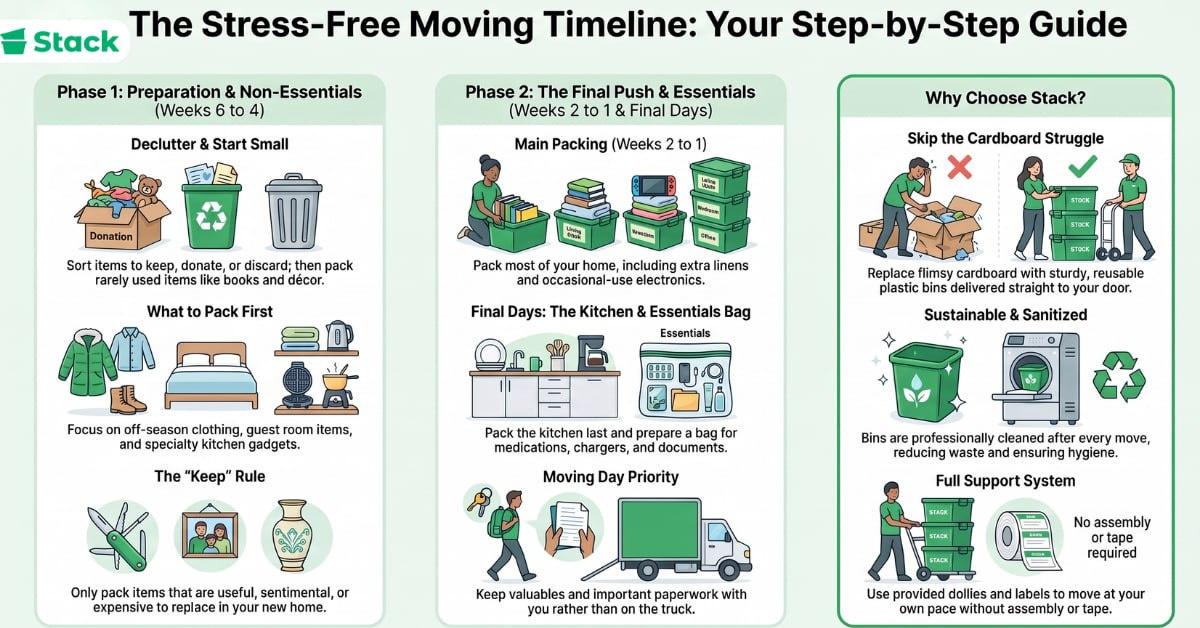
6 Weeks Before Moving: Declutter and Make a Plan
Start by walking through each room and deciding what is actually coming with you. Sort your belongings into things to keep, donate, sell, or discard, paying special attention to seasonal items, holiday decorations, unused appliances, and anything you have not touched in months.
This is also a good time to create a simple moving timeline and start gathering your packing supplies. If you are moving during a busy period, booking your moving company or other moving services early can also give you more options for your preferred date.
4 Weeks Before Moving: Start Packing Non-Essentials
This is where early packing really helps. Start with off-season clothing, books, decorative items, wall art, holiday items, guest-room belongings, and kitchen gadgets or small appliances you can live without for a few weeks.
As you pack, label each box with its contents and the room it belongs in. You can also keep a simple inventory list so you can easily identify what has already been packed and find important items when you reach your new house.
2 Weeks Before Moving: Pack Most of Your Home
By now, most of the non-essential items should already be packed, so you can move on to the things you use occasionally. Pack extra linens and towels, most of your clothes, remaining decorative items, specialty cookware, and anything else you can manage without until moving day.
This is also a good time to use up food from your freezer and pantry instead of packing large amounts of perishables. If you need parking permits, elevator access, building approval, or other arrangements for moving day, take care of those now rather than leaving them until the last minute.
1 Week Before Moving: Finish the Main Packing
In the final week, the goal is to have most of your home packed so you are not dealing with a last-minute rush. Leave out only the clothes, toiletries, chargers, medications, important documents, cleaning supplies, and other essential items you still need for the final few days.
If you are using boxes, make sure you have the right number of boxes and box sizes for what is left. Small boxes are useful for heavier items such as books, while larger boxes can work well for lighter belongings like clothing and linens.
2–3 Days Before Moving: Pack the Kitchen
The kitchen is usually one of the last rooms to pack because you still need it for everyday meals. Aim to pack most of it two to three days before moving, leaving out only the basics you will need until then.
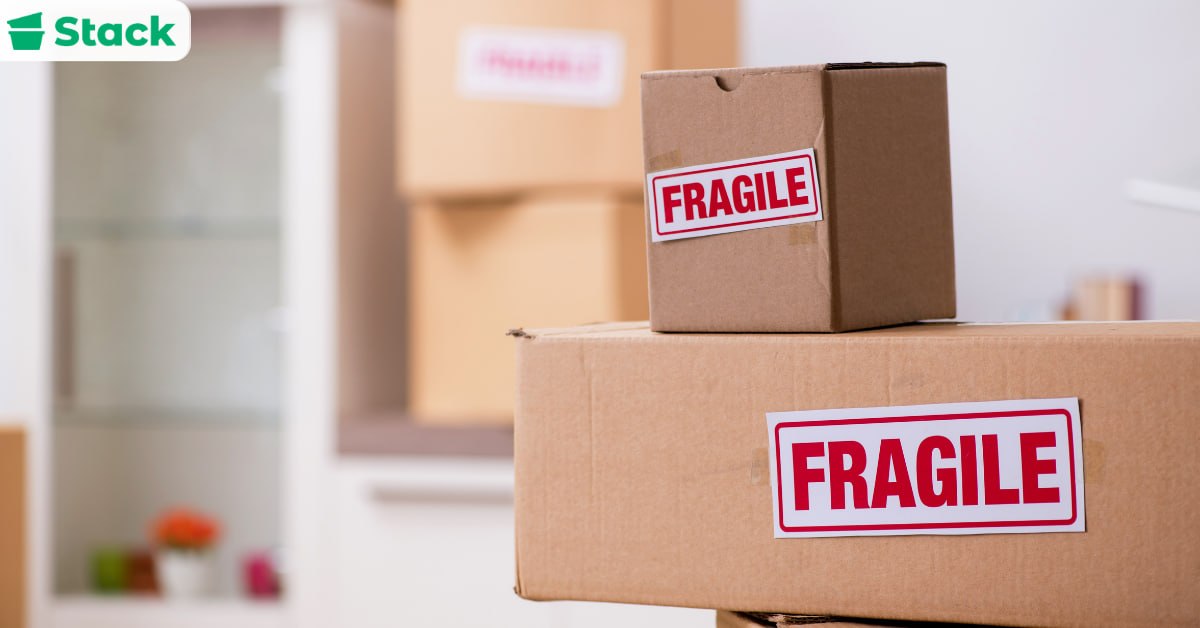
Use sturdy moving boxes or other secure containers for fragile items, and wrap glassware, fine china, and other delicate pieces with packing paper or bubble wrap. Label these containers clearly so they are easy to identify and can be handled carefully during the move.
1 Day Before Moving: Pack Your Essentials
By the day before your move, you should be down to your final packing. Prepare an essentials bag or box with toiletries, a change of clothes, chargers, medications, important documents, toilet paper, snacks, water, and anything else you will need as soon as you arrive.
Keep this separate from your other packed belongings so you can easily identify it when you get to your new space. Your coffee maker, basic kitchen items, and cleaning supplies may also be worth keeping accessible if you will need them before everything else is unpacked.
Moving Day: Keep These Items With You
On moving day, keep valuable items, important documents, medications, personal electronics, and anything with strong sentimental value with you rather than putting them on the moving truck. This gives you peace of mind and means you can access the things you need without searching through packed boxes during the unloading process.
Before leaving your old home, do one final walk-through of each room, including closets, cupboards, the garage, and the medicine cabinet. A quick check can help you catch those easily missed essentials before you lock the door for the last time.
How Long Does It Take to Pack for a Move?
There’s no single answer to how long it takes to pack for a move because every home has a different amount of stuff, and every person has a different schedule. Moving is also fairly common in the U.S.; the U.S. Census Bureau’s 2024 data shows that millions of people move homes each year, whether locally or farther away. U.S. Census Bureau Geographic Mobility Data. With that in mind, your own packing timeline will depend on a few practical factors, starting with the size of your home and how much you actually have to pack.
How Big Is Your Home?
The size of your home is one of the easiest places to start. A studio or small apartment may take much less time to pack than a house with several bedrooms, a garage, dining room, and storage areas filled with belongings.
How Much Stuff Do You Have?
The number of belongings you own can matter just as much as the size of your home. If your cupboards, closets, and storage spaces are full, give yourself extra time to sort, pack, and label everything, especially if you need to decide what is worth taking to your new house.
Do You Need to Declutter First?
Decluttering can add some time at the beginning, but it can save you from packing and moving things you no longer want. If you’re planning to sell items at a garage sale, donate belongings, or sort through sentimental items, starting six to eight weeks ahead gives you more breathing room.
Will You Have Help?
Packing on your own can take considerably longer than having family, friends, or professional organizers help with the job. More hands can make it easier to work through one room at a time, although you’ll still want someone to keep track of what goes into each box and where it belongs.
Are You Moving Yourself or Hiring a Moving Company?
Your moving method can also affect how much preparation you need. With a DIY move, you may need to organize your boxes, moving truck, transportation, and unloading process yourself, while a moving company may handle some parts of the physical move for you.
What Should You Pack First and Last?
Once you have your moving timeline in place, the next question is usually, “What can I actually pack right now?” A simple rule is to start with things you rarely use and leave the items that are part of your everyday routine until the final stages of the move.
|
Pack First |
Why Pack It Early? |
Pack Last |
Why Keep It Accessible? |
|---|---|---|---|
|
Seasonal and out-of-season clothes |
You likely won’t need them before moving day. |
Everyday clothes |
You’ll still need clothes for work, errands, and daily activities. |
|
Books |
You can store most books away without affecting your routine. |
Toiletries |
You’ll need them every day until you leave. |
|
Holiday decorations |
You usually use these only at certain times of the year. |
Chargers and electronics |
You’ll need your phone, laptop, and other devices right up to moving day. |
|
Decorative items and wall art |
Removing them early can reduce visual clutter and make packing easier. |
Basic kitchen items |
You’ll still need to prepare meals and drinks before the move. |
|
Guest-room items |
You can usually pack these without affecting your daily routine. |
Coffee maker |
If coffee is part of your morning routine, there’s no reason to pack it too early. |
|
Rarely used appliances |
Small appliances and kitchen gadgets you rarely use can go into boxes early. |
Medications and medicine cabinet items |
These are essential items you may need at any time. |
|
Extra towels and linens |
Keep only what you currently use and pack the rest. |
Cleaning supplies |
You may need them to clean your old or new space. |
|
Specialty cookware |
Fine china and cookware used for special occasions can be packed early. |
Important documents |
Keep passports, records, paperwork, and other valuable documents with you. |
|
Sentimental and decorative items |
Packing these early gives you more time to organize items with sentimental value carefully. |
Essential items |
Keep anything you use regularly accessible until the final packing stage. |
Following this approach helps you gradually reduce what’s around you without making your home feel unusable weeks before the move. As you pack, label boxes clearly with their contents and destination room, so the unloading process is easier and you can quickly find what you need in your new space.
Should You Declutter Before Packing?
Yes, and ideally you should declutter before you start packing everything into the right boxes. There’s little point spending time wrapping, labeling, and moving something you already know you don’t want, so use the weeks before your move to work through your belongings and decide what is actually worth taking to your new space.
The U.S. Environmental Protection Agency estimates that Americans generated 11.7 million tons of furniture and furnishings waste in 2018, showing just how much unwanted household material can eventually end up in the waste stream. While this figure covers more than just moving-related waste, it’s a good reminder that sorting your belongings before a house move can help you avoid taking unnecessary items with you.
What to Keep
Start with the things you use regularly or genuinely want in your new house. Only the essentials, useful household items, sentimental belongings, important documents, and things that would be expensive or difficult to replace should generally make the keep pile.
What to Sell
If something is in good condition but no longer fits your lifestyle or new space, consider selling it before the move. Furniture, small appliances, kitchen gadgets, decorative items, and other valuable belongings can be listed online or included in a garage sale, giving you a chance to make some money while reducing what you need to pack.
What to Donate
Some items may not be worth selling but could still be useful to someone else. Clothing, books, kitchenware, extra linens, and household items in good condition can often be donated instead of taking up space in your moving boxes.
What to Discard
Be honest about items that are broken, damaged, expired, or simply no longer useful. Getting rid of these things before packing means fewer boxes, less visual clutter, and less to carry through the loading and unloading process.
Once you’ve finished sorting, you’ll have a much clearer idea of how much stuff you’re actually moving. If you’re using reusable plastic clear bins, this is also a good time to work out how many you’ll need, rather than renting or buying more packing containers than necessary.
What Packing Supplies Do You Actually Need?
You don’t need to fill your home with every packing product you can find before a move. The right supplies depend on what you own, how much you’re packing, and how carefully certain items need to be protected, so it helps to start with the basics and add what you need as you go.
Essential Packing Supplies
For most moves, you’ll need containers, labels, packing materials, and a good marker to keep everything organized. Reusable moving bins can be a practical option if you want sturdy containers without buying piles of cardboard boxes, while labels make it easier to identify what’s inside and which room each container belongs in. Stack, for example, provides reusable plastic bins, dollies, and labels that are delivered to your door and collected after you’ve finished unpacking, which can make the packing process a little simpler.
Packing tape can still be useful for sealing certain cardboard boxes, especially if you’re using a mixture of boxes and bins. A permanent marker or color-coding system can also help you quickly identify where each box or bin should go when you reach your new space.
Supplies for Fragile Items
Fragile and delicate items need a little more protection than clothes or books, so this is where packing paper, bubble wrap, and other protective materials become useful. Wrap fine china, glassware, small appliances, decorative items, and other breakable belongings individually before placing them in sturdy boxes or bins, and avoid leaving empty spaces where items can move around during transport.
You don’t necessarily need a huge collection of packing supplies; the goal is to have the right materials for what you’re actually moving. Starting with the basics and adding protective materials for your fragile items can keep your packing process organized without leaving you with a garage full of unused supplies after the move.
How to Pack Efficiently Without Getting Overwhelmed
Packing an entire home can feel like a lot when you look at everything at once. The easiest way to make the packing process more manageable is to break it into smaller steps and focus on what you can get done each day.
Step 1: Pack One Room at a Time
Start with one room and finish as much of it as possible before moving to another. This keeps your boxes organized and helps you see your progress instead of having half-packed boxes scattered throughout the house.
Step 2: Label Every Container
As soon as you fill a box or bin, label it with what’s inside and the room it belongs in. You can also use a color-coding system to make it easier to identify where everything should go when you start unloading at your new house.
Step 3: Keep an Essentials Box
Set aside one box or bin for the things you’ll need immediately after the move. Include items such as toiletries, chargers, medications, important documents, toilet paper, a change of clothes, snacks, and a few basic kitchen items so you don’t have to search through multiple boxes on moving day.
Step 4: Set Daily Packing Goals
You don’t have to pack your entire home in one weekend. Give yourself a small goal each day, such as packing one room, filling a few moving boxes, or sorting through one cupboard, and use your moving timeline to keep yourself on track.
Step 5: Don’t Pack Things You Don’t Plan to Move
Before putting something into a box, ask yourself whether you actually want it in your new space. If the answer is no, put it aside to sell, donate, recycle, or discard instead of spending time and packing materials moving it.
What If You Only Have Two Weeks to Move?
Two weeks isn’t ideal, but you can still have a smooth move if you focus on what needs to be done first. Instead of trying to pack everything at once, split the work across the two weeks and concentrate on the items you can live without first.
Week 1: Declutter and Pack Non-Essentials
Start by going through each room and getting rid of anything you don’t plan to take with you. Once you’ve reduced the clutter, pack non-essential items such as seasonal clothing, books, decorations, guest-room belongings, and rarely used kitchen gadgets.
Week 2: Pack Everything Except Daily Essentials
During the second week, work through the remaining rooms and pack everything you won’t need before moving day. Keep out only everyday clothes, toiletries, medications, chargers, important documents, basic kitchen items, and other essentials, then prepare a separate essentials box that you can easily access.
If you’re trying to save time, reusable plastic bins can also make the packing process easier. Instead of buying new boxes, assembling them, and dealing with tape, you can use sturdy bins that are ready to pack and easy to stack as you move from room to room. Stack Moves offers reusable moving bins, dollies, and labels, which can be delivered before your move and collected once you’re finished unpacking.
Ready to Start Packing for Your Move?
Starting to pack 4–6 weeks before moving day gives you enough time to declutter, pack non-essential and seasonal items first, and gradually work through the rest of your home. As moving day gets closer, focus on everyday belongings, pack the kitchen two to three days before the move, and keep an essentials bag with you for the final day. With a little early packing and a clear plan for each week, you can make the moving process more organized and enjoy a more stress-free move.
If you want to make the packing process easier, Stack Moves provides reusable plastic moving bins, dollies, and labels that are delivered to your door, so you can skip buying and assembling piles of cardboard boxes. You pack everything yourself at your own pace, and once you have unpacked, Stack picks up the bins and cleans and sanitizes them for the next move. Ready to have a successful move? Contact Stack Moves today to get started.
Frequently Asked Questions
Still wondering when to start packing for a move or what to tackle first? Here are some quick answers to common packing questions to help you plan your move in a less time-consuming way.
When should I start packing for a move?
Start packing 4–6 weeks before your moving date. Begin with non-essential and seasonal items, then work towards everyday belongings as moving day gets closer.
What are some signs that indicate it’s time to start packing?
A confirmed moving date and a clear moving plan are good signs that it’s time to start packing. If you know when and how you’re moving, you can begin packing without disrupting your daily routine.
Can I start packing too early for a move?
Yes, packing too early can be inconvenient if you pack things you still use regularly. Start with items you rarely need and gradually pack your everyday belongings closer to moving day.
What are some packing tips for an effective move?
Declutter before packing, work room by room, and clearly label every box with its contents and destination. Keep essential items separate so you can access them easily when you need them.
What should I prioritize when packing for a move?
Start with items you use infrequently, such as seasonal clothing, holiday decorations, books, and decorative items. Leave everyday essentials, toiletries, medications, and basic kitchen items until closer to moving day.
Rent Plastic Bins for Your Move!
Moving with cardboard boxes is a pain. Get pre-assembled bins delivered to your door and move hassle-free with Stack!
Stack eliminates the need for you to source, break down, or fill up your trash can with cardboard boxes.