
How Much Do Moving Boxes Cost?
On average, moving boxes cost between $1 and $8 each, depending on size, material, and where you buy them from. Specialty boxes like wardrobe and dish-pack boxes cost more, often $10 to $40 per box. If you’re looking to save money without sacrificing quality, renting your moving boxes could be a more budget-friendly alternative.
Our mission at Stack Moves is to make moving easier with our sturdy, reusable plastic moving boxes. Made from recycled plastic and backed by 1,100+ Trustpilot reviews, our bins are a simpler, more sustainable way to safely move your belongings. Contact us today to book your moving boxes.
In this blog, we break down moving box costs by size and type, along with the biggest factors that drive prices up or down. You’ll also find real-world cost comparisons and practical tips for spending less, whichever option you choose.
Table Of Contents
- Average Cost of Moving Boxes by Size
- Cost of Moving Boxes By Type
- Cost of Specialty Boxes
- How Much Do Other Supplies Cost for a Move?
- Why Are Moving Boxes So Expensive?
- 4 Factors Influencing the Cost of Moving Boxes
- 4 Common Moving Box Mistakes That Cost You More
- Where to Buy Moving Boxes (and Where They’re Cheapest)
- Ways to Cut Your Moving Box Costs
- How to Estimate Your Moving Box Cost in 5 Steps
- Renting vs. Buying: Which Actually Costs Less?
- Looking for Affordable Moving Boxes?
- Frequently Asked Questions
Average Cost of Moving Boxes by Size

Moving box prices vary primarily by size, with smaller boxes costing less and larger boxes priced higher. Below, we break down the average price ranges and typical dimensions for each standard box size so you can plan your budget accurately.
| Box Size | Typical Dimensions | Price Range | Ideal For |
|---|---|---|---|
| Small | 16″ x 12″ x 12″ | $1-$3 | Books, canned goods, tools, files, small décor |
| Medium | 18″ x 14″ x 12″ | $1.60–$3.50 | Kitchenware, pots and pans, toys, small appliances, pantry items |
| Large | 18″ x 18″ x 24″ | $2-$6 | Bulky items like pillows, bedding, blankets, lampshades |
| Extra Large | 24″ x 18″ x 24″ | $3-$8 | Large blankets, winter coats, bulky clothing |
In some cases it’s worth sizing up even for a heavier item. If something is oddly shaped rather than just heavy, a slightly larger box with proper cushioning may protect it better than forcing it into a small box.
Cost of Moving Boxes By Type
In addition to size, moving boxes are also priced according to the material they are made of and how durable they are. Understanding these material differences helps you choose the right level of protection for your items without overspending.
| Box Type | Price Range | Suited For |
|---|---|---|
| Standard Cardboard | $1-$4 | Everyday items like books, toys, pantry goods, décor |
| Heavy-Duty / Double-Walled | $3-$8 | Dishes, small appliances, glassware, electronics |
| Corrugated | $2-$6 | Fragile or medium-weight items needing extra cushioning |
Cost of Specialty Boxes
Specialty moving boxes are designed to protect fragile, oversized, or high-value items that don’t fit well in standard boxes. While they cost more than regular cardboard boxes, they help reduce the risk of damage during transport.
The table below breaks down the average cost range for each box size so you can quickly compare your options at a glance.
| Specialty Box Type | Average Cost | Typically Used For |
|---|---|---|
| Wardrobe Boxes | $10-$20 | Hanging clothes, suits, dresses, coats, and garments you want to move without folding |
| Dish Pack Boxes | $10-$15 | Plates, bowls, glassware, mugs, and other breakable kitchen items |
| TV Moving Boxes | $20-$40 | Flat-screen TVs, computer monitors, and large electronics |
| Electronics Boxes | $5-$12 | Desktop computers, stereo equipment, and office electronics, large monitors, audio equipment, and bundled electronics |
| Wine Shipping Kits | $7-$15 | Wine bottles, liquor bottles, and other glass containers |
| Mirror Boxes | $5-$8 | Wall mirrors, framed mirrors, and fragile flat glass items |
| Picture Boxes | $5-$8 | Framed artwork, photos, canvases, and prints |
| Mattress Boxes | $10-$20 | Twin, full, queen, and king mattresses during transport |
| Lamp Boxes | $6-$10 | Table lamps, floor lamp bases, and lamp shades |
| File Boxes | $4-$7 | Documents, files, paperwork, and office records |
Not sure exactly how many boxes your move needs? Our moving box calculator breaks it down room by room, so you’re not stuck guessing.
How Much Do Other Supplies Cost for a Move?
Most moves also need a handful of supplies to keep everything sealed, cushioned, and organized in transit. Budget an extra $50–$100 on top of your box costs to cover these essentials for an average move. “Most people don’t realize how much cardboard actually costs once you add extras like tape,” says Sean McGrath. “When we run the math for customers, renting almost always comes out ahead. Plus they won’t have a pile of boxes to deal with after.” Renting plastic moving bins eliminates the need for packing tape and box-sealing supplies entirely, which can save you $20 to $40 on these add-ons alone.
Packing tape runs $2 to $5 per roll, and it’s the one supply almost everyone underbuys, so grab more than feels necessary. For fragile or breakable items like glassware and electronics, bubble wrap costs $10 to $20 per roll, while packing paper ($10 to $30 per pack) fills empty space inside boxes so contents don’t shift during transport.
Larger furniture needs its own protection. Stretch wrap ($10 to $20 per roll) bundles drawers shut and secures loose parts, while moving blankets or furniture pads ($10 to $30 each) guard against scratches and dents when pieces are loaded and unloaded. Finally, labels and markers ($5 to $10) are a small cost that saves real time.
Why Are Moving Boxes So Expensive?
Moving boxes feel expensive because you are buying a single-use product in bulk, at the exact moment you are paying for everything else. A box that costs $2 looks cheap on its own. Forty of them, plus tape and padding, is a different number.
Three things set the price. The first is material: corrugated cardboard is priced by the strength of its walls, so a double-walled box built to carry books costs several times what a single-walled box for linens costs. The second is demand, and it is not small. The US Census Bureau reports that 11.8% of the population moved during 2024, which means tens of millions of households buying boxes in the same few summer months. The third is that you are paying for a product designed to be thrown away.
That last point is where the math turns. According to the US Environmental Protection Agency, corrugated boxes were the single largest product category in municipal solid waste at 33.3 million tons, with a recycling rate of 96.5%. Cardboard is recycled well, but it is still bought once and discarded after one trip, and every mover in that figure paid full price for boxes that had one job.
Rented plastic bins invert that. The same bin is cleaned and reused across hundreds of moves, so the cost is spread rather than repeated, and nothing is left in your hallway to flatten and haul out.
4 Factors Influencing the Cost of Moving Boxes

Several factors can influence the cost of moving boxes, affecting how much you’ll spend on your moving supplies. These factors include material and durability, size and type, quantity, and brand.
1. Material and Durability
One of the biggest drivers of cost is what the box is made from and how much wear it’s designed to withstand. Standard cardboard boxes are intended for short-term use and lighter handling, which keeps production costs lower. Plastic moving boxes, by contrast, are built for repeated use, stacking, and transport. Their added durability, weather resistance, and structural strength naturally place them at a higher price point.
2. Size and Intended Use
Box size alone doesn’t determine cost. What matters more is how the box is meant to be used. Smaller boxes are engineered to carry heavier items without breaking, while larger boxes prioritize volume over weight. Specialty boxes add another layer, as they’re designed for specific items like clothing, dishes, TVs, or artwork. Extra materials, reinforcements, or internal supports increase complexity and, in turn, cost.
3. Quantity and Packing Efficiency
How many boxes you need also affects overall cost. Buying or sourcing boxes individually is usually less efficient than acquiring them in bulk or as part of a bundled solution. Larger quantities reduce per-unit handling, packaging, and distribution costs, which is why bulk options or rentals often offer better overall value for bigger moves.
4. Brand and Quality
Brand pricing often reflects consistency and quality standards rather than just the box itself. Established moving-supply brands tend to use thicker materials, standardized sizing, and stronger construction to reduce failure during transport. Lower-cost options may work for lighter loads but often involve trade-offs in durability, which can matter depending on what you’re packing.
4 Common Moving Box Mistakes That Cost You More
A few avoidable mistakes drive up moving costs more than the boxes themselves. Buying too many large boxes is a common one. It can look like a great idea in the beginning since you get to pack more items with fewer boxes. But this could be very unsafe, especially when you’re dealing with a lot of heavy items. The boxes can become unsafe to lift and more likely to tear.
Another common mistake we see people make is underestimating how many boxes they’ll actually need. We admit that your first and easiest line of action is to eyeball your belongings and guess how many boxes you’d need. But running short mid-move almost always means a last-minute store run. And the reality is these boxes rarely come at the price you budgeted for. Buying too many boxes is just as bad. Those unused boxes translate to money you could’ve used for other parts of the move.
Imagine loading up a free box, only to have the bottom give out the moment you lift it. It seems like a no-brainer to check a box before you pack it, but you’d be surprised how many people skip inspecting a box before packing it. A quick check for dampness, soft spots, or old tears takes a few seconds and can save you from losing whatever was inside it.
Where to Buy Moving Boxes (and Where They’re Cheapest)
Where you buy your boxes affects the price as much as size or type does. Walmart and Home Depot tend to have the lowest prices on standard cardboard boxes. Their prices for small and medium boxes often start from as low as $1 to $3.
U-Haul carries the widest selection of specialty sizes, including dish packs, wardrobe boxes, and TV boxes. These usually come at a slight premium over big-box retailers. Lowe’s prices land close to Home Depot’s, though selection can vary more by location.
Amazon and Walmart.com are the most convenient options if you’d rather not drive to a store, since boxes ship straight to your door. But remember that convenience usually comes with a markup of a dollar or two per box compared to buying in person.
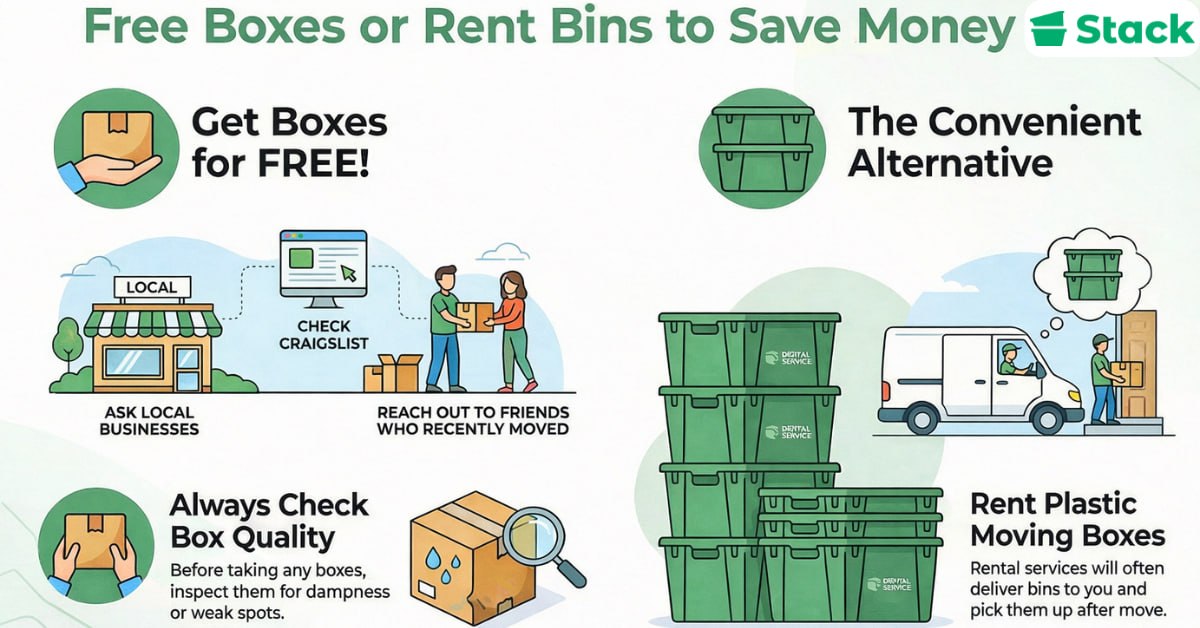
If keeping cost as close to zero as possible matters most, buying isn’t actually your best option. Grocery stores, liquor stores, and local moving groups are often your best bet if you want to find free boxes. We break down the process more clearly in our guide to sourcing free moving boxes.
Ways to Cut Your Moving Box Costs
The easiest ways to cut down on moving box costs are to either use free boxes or rent them instead of buying new ones. You can often find great free boxes from local businesses such as grocery stores, liquor stores, and bookstores.
“Free boxes are a great option if you have the time to source them,” notes Sean McGrath, “but you have to check every box before you commit to it. You’ll lose more than the money saved you if you don’t.”
It also helps to check the online community on Craigslist and Nextdoor, where people are more than happy to give away their leftover boxes. Just be sure to check the boxes for dampness or weak spots before accepting them. Even a quick text to friends who recently moved can land you a full set for $0.
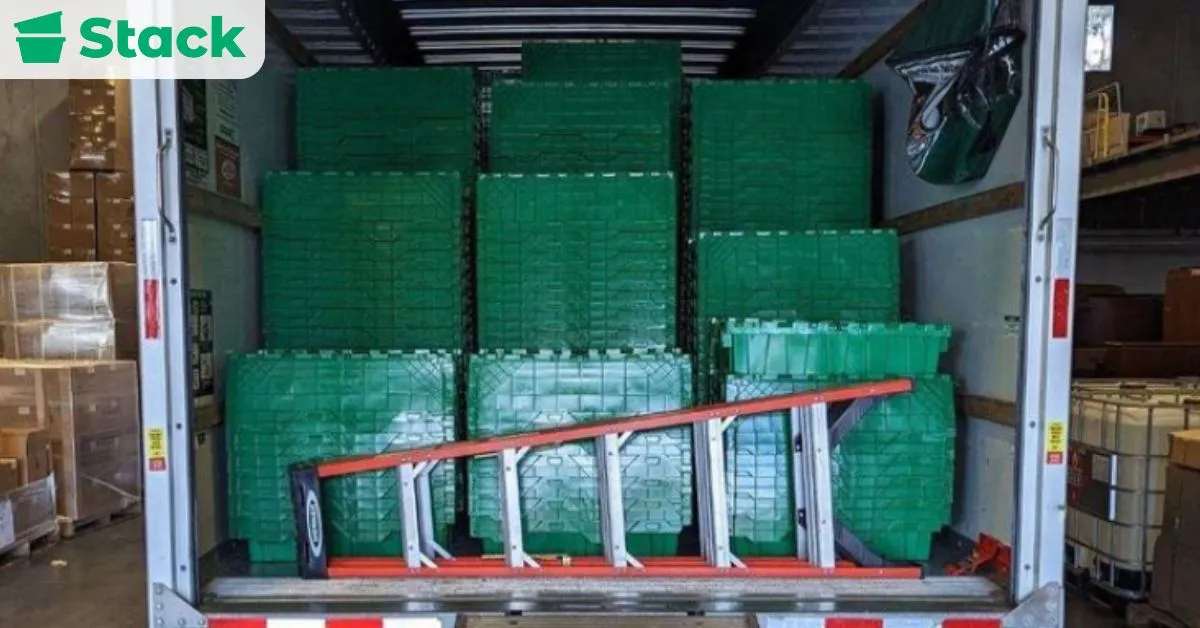
Renting your moving boxes is another money-saving strategy worth considering, especially if your move is on a tighter timeline. Instead of piecing together boxes from multiple sources, you pay one flat rate for exactly what you need. Plus, most rental services deliver the bins and pick them up when you’re done.
How to Estimate Your Moving Box Cost in 5 Steps
Use this to turn a rough guess into a real number before you buy anything.
- Count your rooms, not your stuff. Box needs track room count closely. A studio typically lands around 15 to 20 boxes, a one-bedroom around 25 to 30, and a two-bedroom around 40 to 50.
- Split the count by size. Roughly half small and medium for books, kitchenware and files, and half large for bedding and clothes. Getting this split wrong is the most common way people overspend.
- Add the specialty boxes you actually need. Wardrobe and dish-pack boxes cost far more per unit, so add them individually rather than as a percentage.
- Add supplies. Budget $50 to $100 on top for tape, padding and labels on an average move. Boxes alone are never the whole bill.
- Compare against a rental quote for the same count. Run the same box count through a rental price and compare totals, including delivery, pickup, and the time you would spend sourcing, assembling and disposing of cardboard.
Renting vs. Buying: Which Actually Costs Less?
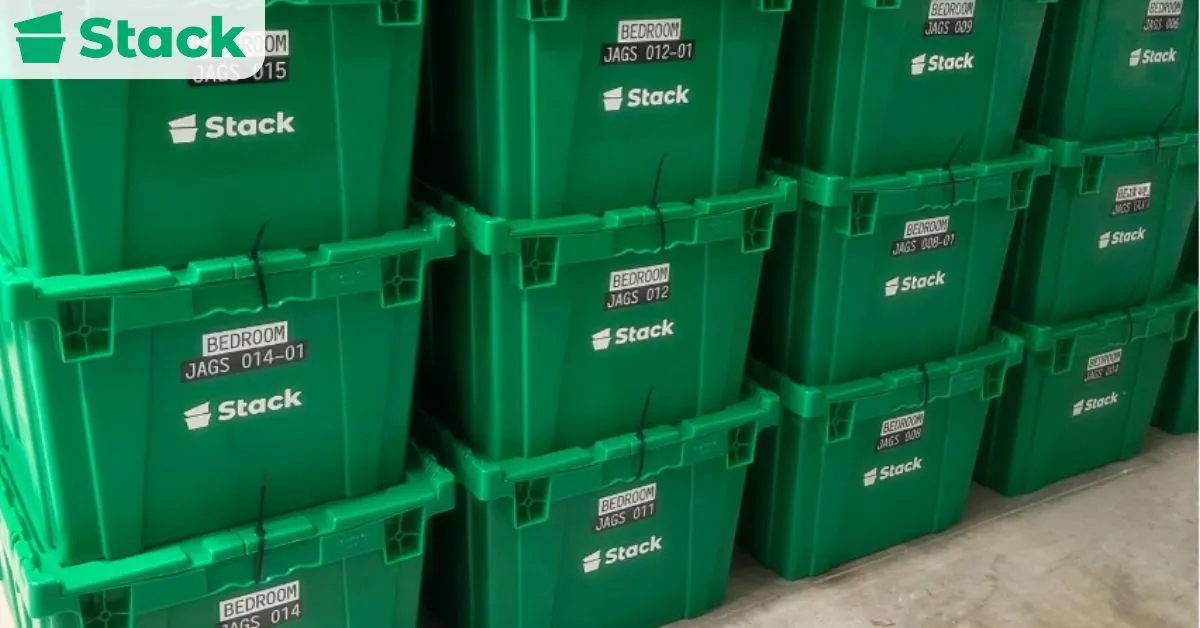
The decision to rent or buy moving boxes comes down to total expense, durability, and convenience. While standard cardboard boxes seem cheaper individually, buying them outright requires extra spend on tape, assembly time, and post-move disposal.
Renting isn’t automatically the better choice for every move. If you’re doing a very small, local move with just a handful of boxes, buying a small bundle outright may still work out cheaper than a rental minimum.
The comparison table below outlines how buying cardboard, purchasing plastic bins, and renting plastic bins stack up across key factors:
| Cost Factor | Buying Cardboard Boxes | Purchasing Plastic Bins | Renting Plastic Bins |
|---|---|---|---|
| Avg. Cost Per Unit | $1-8 | $10-$30 | $1.50–$3 |
| Extra Supplies Needed? | Yes (Tape, paper, bubble wrap) | Minimal | Minimal (Labels included) |
| Assembly Required | Yes | No (Comes pre-assembled) | No (Comes pre-assembled) |
| Weather & Water Resistance | Low (Tears, softens when exposed to moisture) | High (Waterproof, crushproof) | High (Waterproof, crushproof) |
| Post-Move Handling | Break down, recycle, or toss | Store permanently at home | Free scheduled pickup |
Looking for Affordable Moving Boxes?
Moving boxes can make up a significant portion of your moving cost. Buying too many wastes money on boxes you’ll never use, while buying too few means scrambling for last-minute purchases at higher prices. Even choosing the wrong type for what you’re packing puts you at risk of damaging your belongings.
We’ve found that the most convenient and cost-effective way to get high-quality boxes is to rent them. Rental boxes are sturdy, stackable, and reusable, giving you the protection you need without the hassle of storing or disposing of them afterward. Plus, many rental services include delivery and pickup, saving you time and effort. Contact us today to schedule your moving boxes in time for your next move.
Frequently Asked Questions
Moving boxes are one of the most common concerns for people planning a move. Below, we answer the questions we hear most often, offering practical guidance to help you plan your move cost-effectively.
Is It Cheaper to Rent or Buy Moving Boxes?
Renting plastic moving boxes is almost always cheaper and more practical than buying cardboard boxes outright. Buying standard cardboard boxes plus other packing supplies can quickly increase your spending. Renting your boxes gives you durable, pre-assembled bins at a lower flat rate. Plus, when you’re done moving, the company picks them up, so you don’t have to worry about what to do with them after.
How Much Extra Should I Budget for Packing Supplies?
You should budget an additional $30 to $60 on top of your box costs for essential packing supplies like tape, bubble wrap, packing paper, and markers. Heavier or more fragile moves may require extra items like stretch wrap and furniture pads, which can add another $20 to $40. Renting plastic bins often helps lower these extra supply costs since the bins seal without tape.
Where Can I Get Free Moving Boxes Near Me?
You can source sturdy free boxes from local liquor stores, grocery stores, and bookstores, which routinely unpack thick cardboard inventory. Community platforms like Nextdoor, Craigslist, and Facebook marketplace also feature neighbors giving away used moving boxes daily. Just inspect every pre-used box for dampness, weakness, or pests before packing your belongings.
Should I Buy New Moving Boxes?
It depends on your budget, the value of your belongings, and how far you are moving. If you’re moving locally with mostly durable items, used or free boxes are usually fine. New moving boxes make the most sense when you are packing heavy, fragile, or high-value items. We wouldn’t recommend using new boxes if you are on a tight budget or packing light, non-breakable goods like clothing and linens.
How Many Moving Boxes Do I Need a 1-Bedroom Apartment?
Most 1-bedroom apartments require around 25 to 30 moving boxes to pack comfortably. A typical mix includes 10 small boxes, 10 medium boxes, 5 large boxes, and 2 specialty boxes for items like clothes or dishes. If you have a minimalist setup, you can often get by with as few as 15 to 20 boxes.
How Much Does It Cost to Get Moving Boxes for a 2-Bedroom House?
A typical 2-bedroom home requires 40 to 60 boxes, which costs between $100 and $250 if you buy cardboard boxes and packing supplies. Renting reusable plastic bins for a home this size usually runs between $130 and $180 total. This rental option often includes delivery, pickup, and essentials like labels.
Rent Plastic Bins for Your Move!
Moving with cardboard boxes is a pain. Get pre-assembled bins delivered to your door and move hassle-free with Stack!
Stack eliminates the need for you to source, break down, or fill up your trash can with cardboard boxes.
Keep planning your move
- Do You Tip Long-Distance Movers?
- How Much Is the Cost of Movers for a Local Move?
- How Much to Tip Movers for a Long-Distance Move?
- Moving to Chicago Checklist: Pro Tips for a Smooth Move
- What Is the Average Cost of Moving Out of State?
- How Much Do Movers Charge?
- How Much Does Moving Cost From Los Angeles to Seattle?
- Average Moving Cost for a 1 Bedroom Apartment