
How Many Boxes Do I Need To Move?
There isn’t a ballpark answer for how many boxes are needed to move because the number largely depends on factors like your home size, how much stuff you own, and how you’d like to pack. To take out the guesswork, we created a moving box calculator that gives you quick estimates based on the size of your home. This way, you can enjoy your move without overpacking, overspending, or making unnecessary trips to the store to pick up more boxes.
Once you know your total, it’s usually cheaper to buy your boxes in bulk rather than picking up singles as you go.
Stack Moves provides high-quality moving boxes for rent alongside labels and dollies to make your move hassle-free from start to finish. With convenient delivery and pick-up at your new address, there is truly no better moving solution that moving box rentals! Schedule a call to get started.
In this blog, you’ll learn how to determine just how many boxes you’ll need for your move based on your apartment size. We also explore the various factors that can change that number and share where you can find high-quality boxes.
Table Of Contents
- How Many Packing Boxes Do You Need By Home Size?
- Factors Affecting How Many Boxes You’ll Need
- How to Estimate the Number of Boxes Needed for Your Move
- What Box Sizes and Box Types Are Best for a Move?
- Where to Get Boxes for Your Move?
- Packing Tips for Small and Large Moves
- Ready to Take the Guesswork Out of Your Move?
- Frequently Asked Questions
How Many Packing Boxes Do You Need By Home Size?
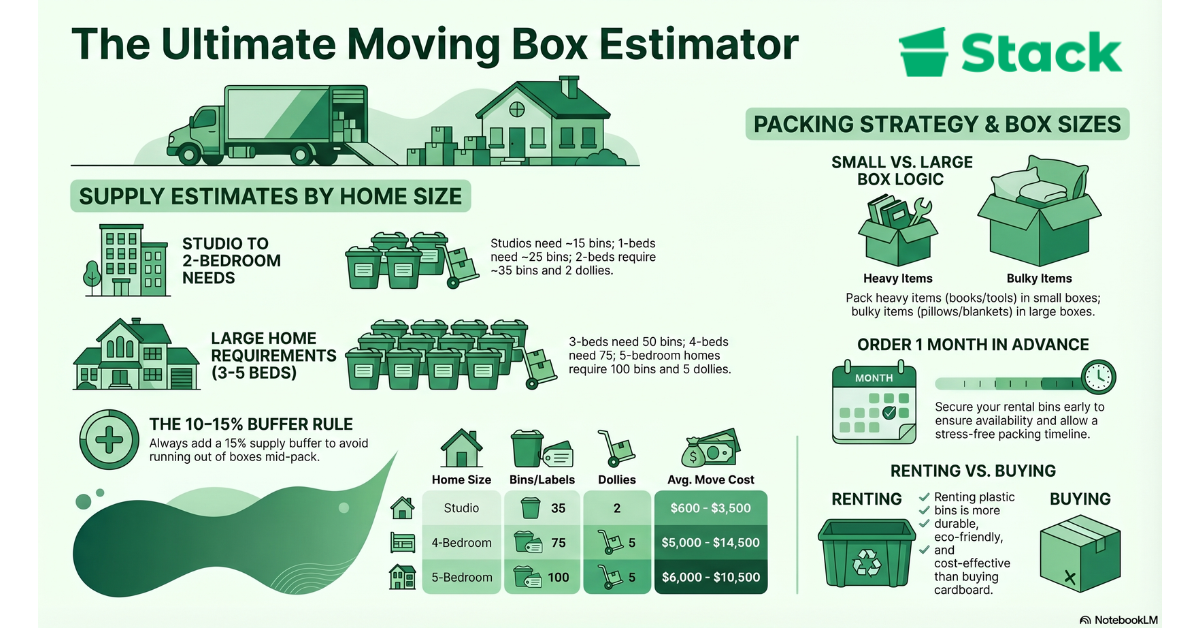
The number of boxes you’ll need depends largely on the size of your home. The bigger your space, the more complex your move becomes. Below, we break down what to expect at each home size so you can plan smarter, not just pack more. Think of this as a quick reality check before moving day hits.
Studio Apartment
15 bins | 1 dolly | 15 labels | Avg. move cost: $200–$1,000
Relocating a studio is usually a straightforward project you can knock out in a single day. The most effective way of managing a move like this is to declutter before you even touch a bin. Doing this will keep your workload light and your costs down. Even though the square footage is small, don’t underestimate how much your closets can hold. So we wouldn’t advise you to leave the packing for the very last minute.
One Bedroom Apartment
25 bins | 2 dollies | 25 labels | Avg. move cost: $300–$1,500
A one-bedroom move usually takes a full weekend once you account for all your furniture and personal belongings. If you are planning a DIY move, it’s a great idea to grab at least one friend to help you out. We recommend packing room by room to keep things organized. It’ll also prevent your main living area from turning into a wall of boxes before you’re ready to load the truck.
Two Bedroom House
35 bins | 2 dollies | 35 labels | Avg. move cost: $500–$2,500
Once you hit the two-bedroom mark, give yourself at least three days for packing to make sure nothing falls through the cracks. A solid labeling system is your best friend here, because it will save you from the headache of hunting for your coffee mug when you arrive at the new place. On average, the cost for professional movers for a two-bedroom apartment typically ranges from $300-$900. While you can still manage this with a dedicated team of friends and family, calling in professionals to assist is a worthwhile investment.
Three Bedroom House
50 bins | 3 dollies | 50 labels | Avg. move cost: $4,000–$10,500
With this much volume, it is best to start packing away non-essential items at least a week before the big day. Moving multiple rooms is a physically draining task. It’s important for you to get all the help you need so you’re not overwhelmed. Breaking the work into smaller phases helps you stay in control and avoids that total exhaustion that often hits during large moves.
Four Bedroom House
75 bins | 4 dollies | 75 labels | Avg. move cost: $5,000–$15,000
For a move like this you have to look out for those hidden storage spots and seasonal items that tend to pile up in larger homes over the years. A multi-day packing schedule is the only way to go so you can focus on the details without feeling rushed. Another important thing is to sequence the move in such a way that allows you to load the largest, heaviest pieces of furniture first. This creates a solid foundation at the back of the truck, which allows you to stack your moving boxes and smaller items safely on top as you work your way toward the door.
5-Bedroom House
100 bins | 5 dollies | 100 labels | Avg. move cost: $7,000–$22,000
When you are moving this much property, a precise tracking system is the only way to stay sane and organized. Trying to handle this scale of work on your own is often more trouble than it is worth and can lead to burnout or broken items. Most families find that hiring professional movers is the most practical choice here to keep their assets safe and the transition successful.
Factors Affecting How Many Boxes You’ll Need

In some cases, your box count might defy these averages we shared earlier. For instance, if you are a minimalist living in a two-bedroom house, you may find that 20 bins are plenty. While our guide gives you a great starting point, you should keep the following factors in mind as you plan your inventory:
- Home Size: The bigger your home, the more boxes you’ll need. A studio apartment requires far fewer boxes than a 4-bedroom house.
- Volume of Belongings: Two people living in the same size apartment can end up with very different needs when moving day arrives. The more you own, the more boxes you’ll need.
- Decluttering: If you take the time to donate, sell, or discard items before packing, you’ll naturally need fewer boxes.
- Box Size Mix: Using the wrong box sizes means wasted space or overloaded boxes. A good mix of small, medium, and large boxes helps you pack more efficiently.
- Fragile or Specialty Items: Delicate items like artwork, mirrors, and glassware require specialty boxes or extra padding, which can add to your total box count.
- Packing Style: If you pack loosely or use a lot of padding material, you’ll use more boxes than someone who packs more tightly and efficiently.
How to Estimate the Number of Boxes Needed for Your Move

Start with a physical walkthrough of your home where you go room by room and mentally group your items into box-sized loads. This helps you get a true feel for the volume and ensures you do not overlook those hidden stashes in cabinets or under the bed.
If you want to skip the mental math, you can also use a moving box calculator to get a quick, reliable estimate based on your home size. This takes the guesswork out of the equation and gives you a solid number to work with right away. Once you have that initial figure, it is helpful to cross-reference it against our home size breakdown, which covers everything from studio apartments to 5-bedroom houses.
After you have a final estimate, make sure to add a 10–15% buffer to your total. Running out of boxes in the middle of packing is a major headache you really want to avoid, so having a few extra bins on hand keeps your momentum going. Finally, do not forget to account for specialty items like artwork, mirrors, and dishes. These pieces need their own dedicated boxes outside of your standard count to ensure they stay protected throughout the journey.
What Box Sizes and Box Types Are Best for a Move?
When it comes to packing, there is no such thing as a best box size for moving. To get the best moving experience, you really need a strategic mix of sizes to protect your belongings and keep the workflow steady. That said, we went ahead to break down exactly what box size works for what to help you make sure every item is paired with its perfect match.
Small Boxes (1.5 cubic feet | 16″ x 12″ x 12″)
Small boxes are your go-to for anything heavy or dense, such as books, tools, canned goods, small appliances, and kitchen utensils. Keeping heavy items in a smaller space makes the box easier to lift and less likely to give way during the move. A good rule of thumb to guide how you pack is to always pack heavy items in a small box.
Medium Boxes (3 cubic feet | 18″ x 16″ x 18″)
They’re ideal for moderately heavy items like toys, small décor pieces, office supplies, and small kitchenware. Basically things that are a bit too bulky for a small box but not light enough to justify a larger one.
Large and Extra-Large Boxes (4.6–6 cubic feet | 18″ x 18″ x 24″ and 24″ x 20″ x 24″)
These are best reserved for bulky but lightweight items like blankets, comforters, pillows, towels, and larger lamps. Large boxes handle most bulky household items well, while extra-large boxes are particularly useful for oddly shaped or oversized items that won’t fit anywhere else. Just be careful not to overload them because size doesn’t mean weight capacity.
Specialty Boxes
Some items simply need their own dedicated packaging. These typically consist of valuable, fragile, and oddly shaped items. A good example of such an item is hanging clothes. Wardrobe boxes let you transfer hanging clothes directly without folding, holding roughly 2 feet of hanging garments. Another example is your dishes. Dish barrel boxes use thick-walled construction to protect fragile kitchenware. More examples of specialty boxes are mirror and artwork boxes, which are custom-sized to keep frames and canvases safe in transit.
Where to Get Boxes for Your Move?
When sourcing moving boxes, the most common options are to buy them new or hunt for free ones. The problem with relying on free moving boxes is that these boxes are often flimsy or damaged from previous use.
Renting plastic moving bins is a much more cost-effective and practical choice that removes the risk of your belongings falling through a weak bottom. When you rent plastic boxes, you only pay for the time you actually need them and return them when you are finished. These bins are far more durable than cardboard, keeping your items dry and secure. Beyond the physical benefits, renting also significantly reduces waste since these sturdy bins can be reused hundreds of times.
To avoid last-minute stress, it is a good idea to book your boxes at least a month before your move date.
This will also give you enough time to assess your needs and order the right number of boxes and other packing supplies, such as packing paper, bubble wrap, and packing tape, so you never have to pack in a hurry.
Packing Tips for Small and Large Moves
Whether you are moving out of a small studio or a large family home, the secret to a smooth transition is a solid packing strategy. Clearly label every box with its contents and the room where it belongs using a bold, permanent marker. This small step helps everyone know exactly where each bin goes the moment it arrives at your new place.
To stay even more organized, keep a master inventory list that details the contents of each box. This is a lifesaver when you are looking for a specific item and do not want to open ten different containers to find it. As you pack, remember to avoid overloading boxes with heavy items. Always place your heaviest items at the bottom of the box to create a stable base and protect your more fragile belongings on top.
One step we’d never advise you to skip in the packing process is to pack a dedicated essentials box for your first night. This should be the very last thing loaded onto the truck and the first thing you open when you arrive. Fill it with everything you will need immediate access to, such as basic toiletries, phone chargers, essential documents, and a fresh change of clothes.
Ready to Take the Guesswork Out of Your Move?
At the end of the day, estimating how many boxes you need is not an exact science. While no guide can give you a perfect, down to the last bin number, our goal is to provide a close enough estimate so you can avoid major surprises.
The quality of your moving supplies is just as important as the number you order. While you could buy brand new boxes, the cost adds up quickly, and relying on used boxes often means dealing with flimsy or unreliable materials. Renting plastic bins is the most practical middle ground, as it offers superior protection for your belongings and significantly reduces the waste that comes with traditional moving. And it’s important to book as early as you can. Reach out to the Stack Moves team today to reserve your plastic moving bins.
Frequently Asked Questions
Still have questions about how many boxes you’ll need for your move? We’ve answered the most common ones below to help you plan with confidence.
How Far In Advance Should I Order Moving Boxes?
It’s best to order your boxes at least a month before your move date. This gives you enough time to pack without rushing and ensures your preferred box type and quantity are available.
How Many Boxes Do I Need For a Kitchen?
For an average-sized kitchen, you’ll need around 17–22 boxes depending on the size mix you use. This covers everything from cutlery and pantry staples to pots, pans, and fragile items like plates and glasses. Check out our dedicated kitchen section above for a full breakdown by box size.
Is It Better To Rent Or Buy Moving Boxes?
Renting is almost always the better option if you’re looking to save money and reduce waste. Plastic rental bins are more durable than cardboard, offer better protection, and you simply return them when you’re done.
How Do I Know If I Have Enough Boxes?
Estimate your needs room by room, then add a 10–15% buffer to your total count. Our home size guide above gives you a solid starting point, but when in doubt, it’s always better to over-order slightly than to run short on moving day.
What Is The Most Common Moving Box Size?
The medium box (around 3 cubic feet) is the most commonly used size for general packing. It’s versatile enough for a wide range of household items without becoming too heavy to lift comfortably.
Can I Reuse Old Boxes For Moving?
You can, but always check that they’re still in good condition before packing anything valuable in them. Old or previously wet cardboard weakens over time and can give way under the weight of your belongings.
How Do I Pack Fragile Items Safely?
Always use specialty boxes for your most delicate items, for example, dish barrels for kitchenware and mirror boxes for artwork. Wrap each item individually in packing paper or bubble wrap, and fill any empty space in the box with padding to prevent shifting during the move.
Rent Plastic Bins for Your Move!
Moving with cardboard boxes is a pain. Get pre-assembled bins delivered to your door and move hassle-free with Stack!
Stack eliminates the need for you to source, break down, or fill up your trash can with cardboard boxes.