
How to Organize Your Office Move With Office Moving Labels
Without a clear system in place, even a small business relocation can become difficult to manage once packing and unloading begin. The most effective way to label boxes for an office move is to include the department name, destination room, box contents, and any handling instructions on each label. Also place the labels on multiple sides of the box so they remain visible no matter how the boxes are stacked, carried, or unloaded.
At Stack Moves we understand that labeling is an important part of any move, be it corporate or residential. That’s why every moving box rental comes with a corresponding number of labels to help you stay organized. You’re also welcome to ask for more labels if you want, we’re happy to provide extras.Contact us today get started.
In this guide, you’ll learn how to organize your office move with office moving labels. We’ll also cover how to create a labeling system, label office equipment and boxes correctly, and avoid common office moving mistakes.
Table Of Contents
- How to Create an Office Moving Label System Step by Step
- Benefits of Using Labels During an Office Move
- Types of Office Moving Labels You Can Use
- Best Practices for Labeling Office for Office Moves
- Common Mistakes to Avoid When Using Office Moving Labels
- Need a More Organized Way to Handle Your Office Move?
- Frequently Asked Questions
How to Create an Office Moving Label System Step by Step
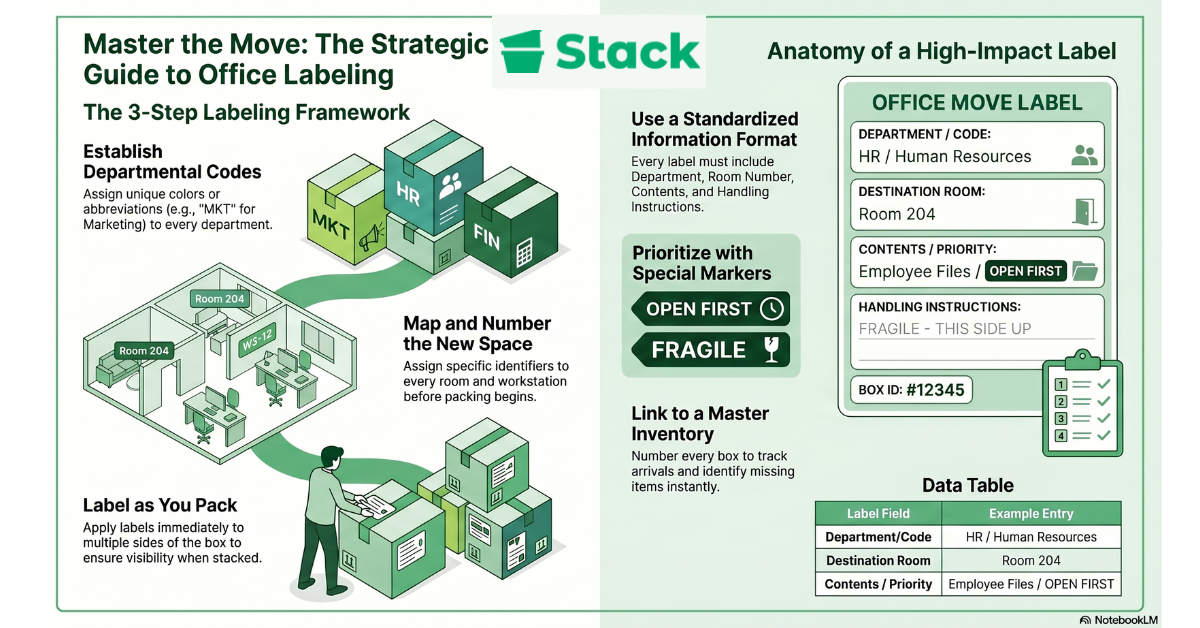
Because office movers depend on your labels to avoid delays on moving day, it’s important for all labels to follow the same format. The consistency in labeling makes it easier for anyone handling the boxes to understand them instantly without confusion. We put together a 6-step guide to help you build a simple and consistent moving-label system that keeps your move organized.
1. Assign a Labeling System for Each Department
First, decide how you want to identify each department throughout the move. This will be the foundation for your entire labeling system and help movers quickly recognize where each box should go without needing instructions. Most offices do this by assigning each department a color, abbreviation, or both. The important thing is to keep the system simple and consistent so everyone can understand it immediately.
You can use department codes like “HR” for Human Resources and “MKT” for Marketing. Once these codes are established, they should appear on every box, piece of furniture, and moving label connected to that department.
2. Number Offices, Rooms, and Workstations
The next step is to clearly number every office, room, and workstation in the new space. Without room numbers, labels like “Marketing” or “HR” are still too broad and can easily lead to boxes being dropped in the wrong areas. Walk through the new office space and assign simple identifiers to each area, such as numbers or codes that are easy to track. For example, if the finance department has three rooms, you could label them Office – FIN-001, FIN-002, and FIN-003. Once these identifiers are finalized, share them with employees and movers before packing begins so everyone is working from the same system.
3. Decide What Information Goes on Every Label
One of the biggest mistakes offices make during a move is allowing employees to label boxes however they want. Some people write detailed descriptions and others barely write anything. In some cases, nothing gets written at all. To avoid this, every box should follow the same labeling format.
Decide exactly what information must appear on every label before you start packing. This keeps the system organized. A good office moving label should include the department’s name or code, destination room number, brief description of its content, and any necessary handling instructions. For example, HR-204 – Employee Files – Open First.
4. Label Boxes Before Packing Is Finished
Many people make the mistake of waiting until they’re finished packing before they start labeling. The issue with this approach is that it often leads to incomplete or inaccurate labels, since details are easier to forget once boxes are already sealed. A much more effective way to label your boxes is to label them as you pack. You’re less likely to forget anything this way, plus, it helps everyone stay organized throughout the process. Remember to place your labels on multiple sides of each box, not just the top, since stacked boxes can easily hide key information during loading and unloading.
5. Create Special Labels for Important or Fragile Items
Some boxes may contain fragile electronics, confidential documents, or supplies that need to be unpacked immediately once the office is operational again. With special labels, these boxes are easier to identify and prioritize during the loading and unloading process.
The easiest way to do this is by using bold text, brightly colored stickers, or labels with clear handling instructions that stand out from your regular moving labels. For example, you can use labels like “OPEN FIRST – Reception Supplies” or “CONFIDENTIAL – HR Files.” This helps prevent important items from getting buried underneath less urgent boxes during the move.
6. Share the Labeling System With Employees and Movers
A labeling system only works if everyone involved in the move understands how to use it. Take time to explain the system to employees and movers before they start packing. This includes explaining department codes, room numbers, label formats, and any special handling labels being used during the move. Giving everyone the same instructions ahead of time helps unloading move faster, reduces confusion, and keeps boxes from ending up in the wrong rooms.
Benefits of Using Labels During an Office Move
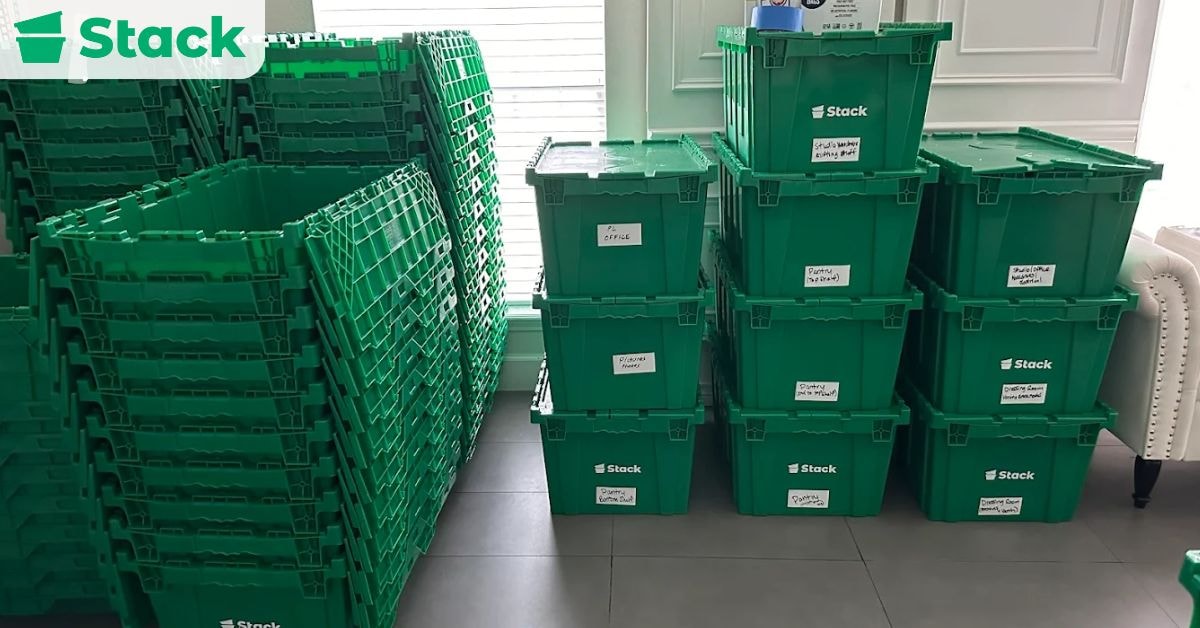
When an office move isn’t properly organized, boxes can end up in the wrong rooms and equipment can go missing. To avoid this, combine your labeling system with an office moving checklist to keep the transition seamless. A clear labeling system prevents confusion on moving day by making sure every box, piece of equipment, and file is directed exactly where it needs to go from the start.
It also speeds up the unpacking process, helping teams get back to normal operations with less disruption and downtime. Beyond efficiency, proper labels help protect sensitive documents, keep IT equipment correctly routed, and make coordination between employees and movers far more seamless during the relocation.
Types of Office Moving Labels You Can Use
Labels are designed to support different moving conditions and handling environments. Choosing the right combination can make sorting and unpacking more efficient and reduce errors during an office relocation.
- Color-Coded Labels: These are used to assign visual identity to different departments, rooms, or floors. Each color represents a category, making it easier to sort boxes quickly during loading and unloading without needing to read every label in detail.
Pre-Printed Moving Labels: These come with pre-set fields such as “Room,” “Box Number,” and “Contents,” helping teams stay consistent across all boxes. They’re especially useful in structured office moves where multiple people are packing and you want every label to follow the same format.
Blank or Writable Labels: These are flexible labels that allow you to customize information as you pack. They work well for smaller offices or situations where contents and box assignments may change during the packing process.
Durable or Weather-Resistant Labels: These are designed for situations where boxes may be exposed to heat, moisture, or heavy handling. They help prevent smudging, peeling, or fading so important information stays readable throughout the entire move.
Best Practices for Labeling Office for Office Moves
A clear labeling system reduces confusion and makes it easier to unpack important items first. These labeling techniques will ensure key items don’t get lost in the shuffle and your workflow resumes quickly.
Label by Room for Quick Setup
Label your boxes with their destination, i.e., where the items in them should be placed, instead of where you packed them from. Write things like “HR-File Cabinet” so that movers can place the boxes exactly where they need to be in the new space. This quickens the unpacking process and makes it easier for team members to find their belongings right away.
All our rental packages are designed to match the size of your move, making sure you have the right number of bins for your move. You can even use our moving bin calculator to determine the best bin package for your needs.
Use Numbering to Track Every Bin
Another way to label your boxes is to number them and link the boxes to your inventory list. For example, Box 12 could be “Admin-Printer Toner.” An advantage to using this method is that if the box goes missing or arrives late, you know exactly what’s inside it.
Prioritize What Gets Unpacked First
You can also try labeling your boxes according to priority so that high-priority boxes are unpacked first. Use tags like “Priority 1 or Unpack First” so that your essential operations aren’t held up while the rest of the office is still being set up.
Combine Methods for Better Organization
To really stay on top of things, you can combine different methods. A bin labeled “Box 8 – Marketing – Priority 2 – Event Supplies” tells your movers what to do and when to do it. Small details like this make the transition easier for everyone involved.
Common Mistakes to Avoid When Using Office Moving Labels

Even with the best intentions, labeling systems often break down during real office moves because people prioritize speed over structure. This often leads to hidden delays that can significantly inflate your office moving costs. Although labeling is often treated as a simple task, in reality, labeling mishaps can potentially jeopardize your entire move. Below are five common mistakes people make when preparing for an office move, along with the correct approach to avoid them.
1. Using Vague or Generic Labels
People often write vague labels like “cables,” “documents,” or “marketing stuff” because it feels faster during busy packing periods. The problem is that these labels don’t help anyone differentiate between multiple boxes with similar contents once everything arrives at the new office. Instead, use specific identifiers like “Marketing – Desk Supplies” or “Finance – Client Files Q1.” This makes unpacking faster and helps employees locate exactly what they need without opening multiple boxes.
2. Inconsistent Label Formats
Different team members will naturally label boxes in their own style. Some will use room names and others may use abbreviations. While this seems harmless, it creates confusion when boxes are being sorted in bulk by movers who don’t understand internal shorthand. A consistent format (e.g., Department – Room – Contents – Box Number) solves this immediately. The result is a system that anyone can read quickly without interpretation.
3. Labeling Only One Side of the Box
Many people assume the top of a box is enough because it’s the first thing they see when packing. However, once boxes are stacked or moved around, that label often disappears from view entirely. This slows down unloading because movers have to rotate boxes just to identify them. Labeling at least two sides plus the top ensures visibility no matter how the box is placed.
4. Skipping Box Numbers or Tracking Systems
In smaller moves, teams often skip numbering boxes because they believe they can keep track of them mentally. The issue is that once dozens of boxes are in transit, it becomes nearly impossible to confirm whether anything is missing. Adding box numbers tied to a simple inventory list removes that uncertainty completely. It gives you full visibility over what has been packed, moved, and delivered.
5. Not Highlighting Priority or Sensitive Items
People usually focus on labeling what’s inside but forget to signal importance. As a result, essential items like IT equipment, urgent files, or fragile hardware can end up treated like standard boxes. This happens because urgency is not visually communicated. Using clear markers like “FRAGILE,” “OPEN FIRST,” or “IT EQUIPMENT” ensures priority handling and reduces the risk of damage or delays in setup.
Need a More Organized Way to Handle Your Office Move?

Even with a clear structure in place, low-quality packing boxes can slow down the entire moving process. Weak boxes can collapse under weight, make stacking unstable, and cause labels to peel or become unreadable during transport. When that happens, even a well-planned labeling system starts to fall apart.
With high-quality moving boxes, labels stay firmly in place, boxes stack safely without shifting, and teams can move through packing and unpacking with far fewer interruptions. In practice, better supplies support better organization, making the entire move easier to manage from start to finish.
At Stack Moves, we provide high-quality plastic moving boxes designed to keep your office relocation organized and stress-free. Each rental comes with labels included, helping you and your team stay consistent and efficient throughout the packing and unpacking process. Contact us today to reserve your moving boxes ahead of your next office move.
Frequently Asked Questions
Here are a few quick answers to the most common questions about setting up a workspace relocation sorting system. These tips will help your team and movers stay organized throughout the relocation process.
Why Is Proper Labeling Important During an Office Relocation?
Proper labeling helps keep the entire office relocation organized from start to finish. It ensures that packing boxes are delivered to the correct office space without confusion or delays. With clear labels, movers can quickly place items in the right areas in the new location. This reduces downtime and helps the moving process run more smoothly.
What Should Be Included in Office Moving Labels?
Office moving labels should include the department name or code, the destination room, a short description of contents, and any handling instructions. This gives movers and employees clear packing instructions and reduces confusion during the move. It also helps ensure belongings arrive safely and end up in the right place. Keeping the format consistent across all packing boxes is key.
What Is the Best Way to Place Labels on Packing Boxes?
The best approach is to place labels on multiple sides of each box, not just the top. Since boxes are often stacked during transport, proper label placement makes them easier to identify at all times. This helps movers quickly sort items based on the floor plan and room assignments. It also speeds up unloading in the new office space.
How Can You Make Sure Everything Arrives Safely at the New Office Space?
The key is combining proper labeling, structured packing instructions, and good packing supplies. Every item should be clearly labeled based on department and destination so nothing gets misplaced during the move. Movers can then follow the system without confusion, reducing errors during transport. This helps ensure a smooth office relocation and safe arrival of all belongings.
Rent Plastic Bins for Your Move!
Moving with cardboard boxes is a pain. Get pre-assembled bins delivered to your door and move hassle-free with Stack!
Stack eliminates the need for you to source, break down, or fill up your trash can with cardboard boxes.